‘Ethnographic fieldwork must be designed accordingly, comprehending and exploiting the logics and peculiarities of digital media.’ (Airoldi, 2018)
This week, I started with demolishing my first pitch and inventing a media niche that I am better equipped to study. Instead of creating a Poetry Youtube account, which would be too difficult, I will be writing and posting investigative essays on the spoken word videos I watch – dismantling, praising and reviewing the meaning of the poems.
At the heart of my DA, I am producing a foundation of strong ethnographic research first. In narrowing my field site, I am building connections in the world of online spoken word poetry, noting both human and non-human factors. The field site is ‘the lived experience of a network of relations’. (Moore, 2020)
Through branching off people, communities, fans, artists, slam organisations, personas, things, content, motivations, agency, places, websites, blogs, online platforms and social media, I am identifying a holistic mapping of the field site. ‘Field site’ details the ‘stage on which the social processes under study take place’. (Burrell, 2009)
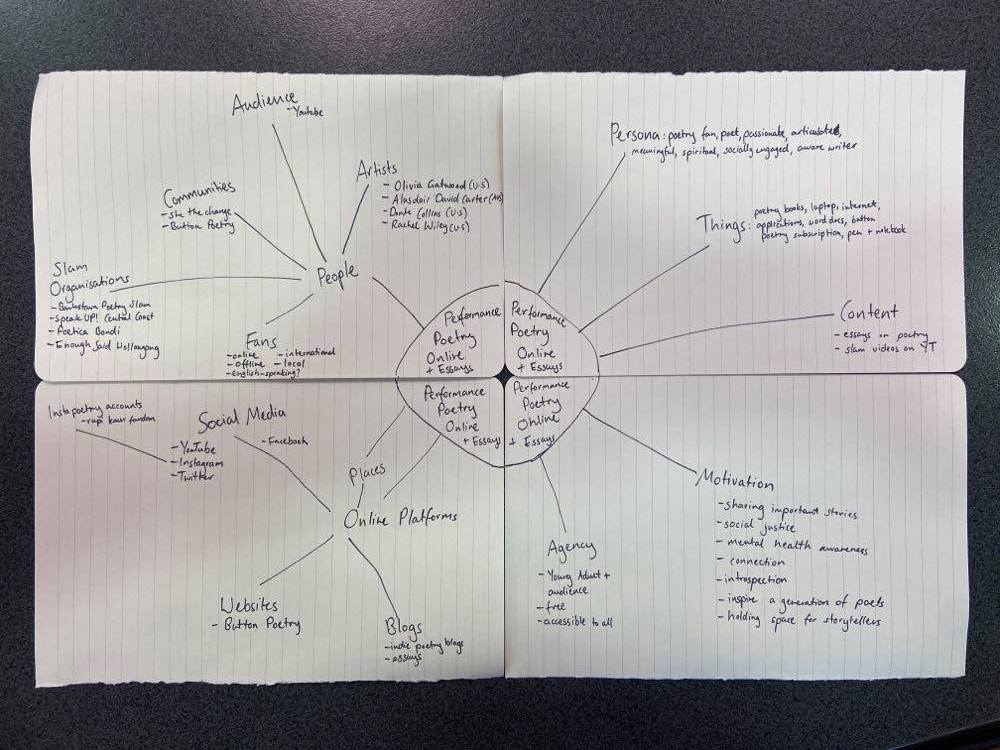
I am looking critically at what socio-cultural message the artist delivers, how we consume it, where we consume it, who consumes it and what implications the consumption of the poetry has. I am most interested in studying the motivations of my proposed field site.
Significantly, observational research could cover most areas of my field mapping areas. It is, however, most applicable to researching online platforms and watching social media engagement for spoken word videos. Collating observation results from the fans, communities, organisations, audiences of poetry is more achievable than another research method. Additionally; transcription, analysis and interpretation are extremely valuable methods to dissect content and motivations. My case studies are the poetry videos I watch and write essays on, from predominantly Button Poetry artists.
Journaling will be a central part of my ethnographic research, and I plan to rely heavily on autobiographical, descriptive and analytical forms of writing. I’m going to break up my essays into these steps:
- Choose a poem on YouTube to watch (case study)
- Divide the structural approach to the essay into parts
1. Document and record the first reaction to the poem
2. In-depth analysis of the techniques, theme and overall meaning
3. Write openly, connecting the personal to the cultural,
b) and from social and cultural aspects to the personal
4. Conclude essay with holistic view of my own experience (autobiographical reflection), and the experience of the audience and community (observational research – from YouTube, Instagram and Twitter.)
Through careful and connected ethnographic fieldwork, I aim to present research findings that reveal the true positive effects of spoken word poetry on it’s audience.
References
Airoldi, M., 2018. Ethnography and the digital fields of social media. International Journal of Social Research Methodology, [online] 21(6), pp.661-673. Available at: <https://doi.org/10.1080/13645579.2018.1465622>.
Ardévol, E. and Edgar Gómez-Cruz, E., n.d. Digital Ethnography and Media Practices. [online] Upf.edu. Available at: <https://www.upf.edu/documents/237797533/238831346/Digital_ethnography_and_media_practices.pdf/a6427a17-72cb-2629-0b46-cce0df93e33f>.
Burrell, J., 2009. The Field Site as a Network: A Strategy for Locating Ethnographic Research. Field Methods, [online] 21(2), pp.181-199. Available at: <https://doi.org/10.1177/1525822X08329699>.
Moore, C., 2020. BCM241 Media Ethnographies Blog Post Two. University Lecture presented on YouTube. Media Ethnographies, BCM 241. The University of Wollongong. August 4th, 2020.
 internet kid