As a young Australian, I bow to Netflix and Stan as the royals of streaming. Although my main allegiance is to the Kingdom of YouTube for entertainment, I do admit to ‘bandwagoning’ and I have dabbled with trending ‘binge-worthy’ shows including Netflix’s ‘Stranger Things’.
The pace at which society consumes television is getting faster. We now binge a 12-hour series in two days without a thought. Netflix originals ‘Stranger Things’, ‘Orange is the New Black’, ‘Mindhunter’ and ‘13 Reasons Why’ are productions that have gained binge status. They are easy watches and easily addictive. But is it dangerous?
“How to Look at Television,” a 1954 journal article by Theodor W. Adorno for The Quarterly of Film, Radio and Television; presents concerns for the unknown potential dangers of TV. (Pitre, 2019) Adorno writes, “By exposing the socio-psychological implications and mechanisms of television, often operating under the guise of fake realism, not only may the shows be improved, but, more important, possibly, the public at large may be sensitised to the nefarious effect of some of these mechanisms.” (Adorno, 1954)
Australia has always looked to entertainment-dominating countries like the U.S and England for television. I can’t even recall a time I’ve watched a foreign television show religiously like I have done with western TV e.g the Disney Channel and Nickelodeon. We enjoy a mass range of American/British media because of the cultural similarities we share as western societies. The idea of cultural proximity applies to global television in the instance of American/British TV appealing to Australians as the content is familiar to us. We understand the comedy, we speak the same language, we have the same pop culture references. It is natural for us to lean toward culture we know. At the same time, we tend to reject cultural products that are too distant from our own cultural reality. (Straubhaar 2007, 91) This is why Channel 9 doesn’t play Japanese game shows or Spanish soap operas. We can’t relate or understand easily.

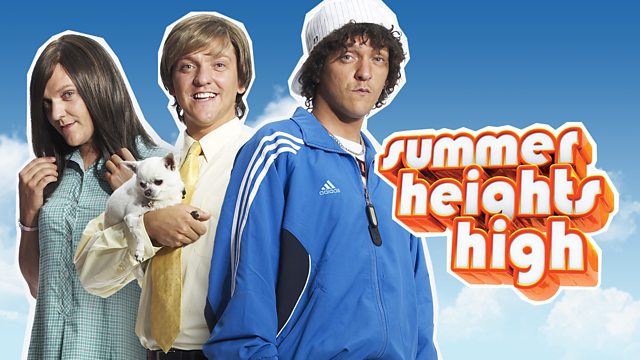
Chris Lilley’s “Summer Heights High” soared globally due to the stereotypical characterisation (Gay drama teacher, mean school girl) and satirical humour that appealed to a universal audience. You don’t need to be Australian to understand Chris Lilley comedies, whereas Kath and Kim fails globally because the humour is distinctly and exclusively Australian (specifically the high use of slang and references explain its failure to reach international audiences). Channel 7’s Puberty Blues also didn’t make it overseas as a result of the inherently Australian references including ‘Chiko rolls’, ‘Vaso’, (and the Shires surfing and drugs complex) that just do not translate well. The Office (U.S) succeeds because of the comedic play on the everyday mundane work filmed as a mockumentary style comedy.
References:
JSTOR Daily. (n.d.). A Critical Theory of Binge Watching | JSTOR Daily. [online] Available at: https://daily.jstor.org/critical-theory-binge-watching/ [Accessed 30 Aug. 2019].
Oxfordbibliographies.com. (2019). Maya Deren – Cinema and Media Studies – Oxford Bibliographies – obo. [online] Available at: https://www.oxfordbibliographies.com/view/document/obo-9780199791286/obo-9780199791286-0115.xml [Accessed 23 Aug. 2019].
Straubhaar, Joseph, D. ‘Choosing National TV: Cultural Capital,
Language and Cultural Proximity in Brazil’ in The Impact of
International Television: A Paradigm Shift’, edited by Michael G.
Elasmar, Oxofrd: Routledge, 2014, pp. 77-110.
 internet kid